
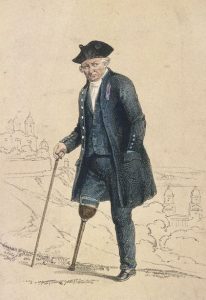
 In 1848, unfettered by so-called ‘political correctness’, two teams of Greenwich Pensioners, resident at the Royal Hospital for Seamen in Greenwich, took part in a spirited, and well-received, two-day cricket match at the Priory Ground in Lewisham. The names of the teams are, hopefully, self-explanatory, but all the players were retired Royal Navy sailors, who had lost their respective limbs in the cause of duty and, hence, found a permanent home at the Royal Hospital.
In what I suspect was meant as a nod toward camaraderie but also respect for the service of those involved, the match was met with a positive reaction, and depending on how you perceive it could even be said to be ahead of its time. Of course nowadays sporting events for those with certain physical limitations are rightly heralded as inclusion and necessary in rewarding achieve just as they are in the able bodied. The paralympics was of course a recent brilliant example of showcasing sporting achievement in those with additional challenges.
 Gone are the days where cricket had a narrow appeal. Branching out beyond the physical, cricket has been dragged into the modern age in varying regards. Take for instance ‘The Hundred’. This new format aimed at appealing to new audiences achieved just that, selling over 500,000 tickets, and reaching a TV audience of 16 million+. Not only that, 57% of those tuning in had not watched live cricket this year. The key to its success was to involve both mens and womens teams (from various major cities across the country – making it more diverse). It’s a 100 ball tournament and all signs are that it’s bringing a new and younger audience to the sport, which can’t be bad. Of course Cricket already holds mass appeal all around the world, from the UK to India, as sites like https://crictips.com/ attest to, so hitting on new angles to keep things fresh and interesting is key to continued interest.
The aforementioned One Arm and One Leg cricket match appears to have been something of a ‘jolly’ for the Greenwich Pensioners, each of whom received an allowance of ten shillings, not to mention free transport to and from the Priory Ground. Eating and drinking were high on the agenda, with a generous lunch and dinner served before and after each day’s play and, at the end of the match, both teams marched off, with musical accompaniment, to the Bull Inn in nearby Shooters Hill.
While the players cut a dash in their distinctive veterans’ uniforms, their age and infirmity led to a rather comical, if good-natured, encounter, in which extras made a significant contribution to the totals in all four innings. The One Arm XI bowled 43 wides and the One Legged XI 30, while Mr. Sears, who batted at number five for One Legged XI, top scored with 15 in the second innings. All told, the One Arm XI made 50 and 41 and the One Legged XI made 32 and 44, although the batting was as bad as the bowling, with 21 ducks in the match, including five pairs for the One Legged XI.
 IN a festival that includes three Group One races, it may seem somewhat surprising that the Ebor Handicap is arguably the most attractive clash of the four days at York.
One of the most valuable flat handicaps in Europe, the Ebor offers a first prize of £300K, and it is no surprise the race attracts high quality entries from both flat and hurdles background.
The horse bets are currently led by trained Saeed bin Surur, four-year-old Live Your Dream, winner of four out of seven starts, including over £ 1 million in the Bet365 Trophy at Newmarket in July. Prior to that, Wolverhampton had a comfortable six-length, two-mile success so endurance was no problem for Iffraj’s son Godolphin.
With form at the track another consideration for punters, Live Your Dream ran a very creditable second to Spanish Kiss in a 1m4f handicap on the Knavesmire in May this year – coming on considerably in his outings since, so BBC Sport
Live Your Dream missed the whole of 2020 so appears to have some catching up to do, with Saeed bin Suroor saying: “The Ebor looks the race for him. He’s improving – he came out of his last race nicely and he’s in good form.
“He’s probably a Group Three horse at the moment, but I think you need a Group horse for the Ebor, so we’ll take it from there. Good ground would be what he wants.”
With the record of favourites in the Ebor reading one winner in the last 13 runnings, with ten of those 13 winners going off at double-figure odds, you may be forgiven for giving Live Your Dream (8/1) a swerve, but the colt is unaware of where he is in the betting, and his credentials appear to underline why he is the standout entrant in the race.
There will be a strong challenge to Live Your Dream from Ireland, with Willie Mullins and Johnny Murtagh bringing over runners that are just behind the favourite in the betting, reports SportShock.Net.
Mullins will head into the race with a number of runners, Saldier leading the way at a price of 12/1. However, he would have to buck the trend of seven-year-olds in the race, with just one horse aged over six winning in recent history – Litigant producing a shock success in 2015 at a price of 33/1, handing trainer Joseph Tuite the biggest success of his career.
Saldier has the Galway Hurdle under his belt this season, with famous hurdle winners proving successful in the past; the race famously won by Sea Pigeon in 1979, a horse that was better known for his steeplechase efforts, winning the Champion Hurdle twice, in 1980 and 1981. Aside from his hurdles success, Saldier’s flat form is perhaps more interesting, winning a qualified riders’ race at Listowel over the Ebor trip; he was also fifth in the Copper Horse Handicap at Royal Ascot off his Ebor mark.
Johnny Murtagh has Sonnyboyliston (12/1) and Mirann (20/1) down to run in the race, with the former potentially a better prospect than Saldier. Sonnyboyliston finished seventh at York in the Group Three John Smith’s Silver Cup in July over the Ebor distance, and he would be trainer Murtagh’s second win in the race after Mutual Regard’s success in 2014.
Beforehand, the Totepool Flexi Betting at Cheltenham Festival Novices’ Chase, run over 2 miles 4 furlongs, at Towcester on March 17, 2011 hardly appeared a horse racing moment that would make history, but it did. Just four runners went to post, but that number was reduced to two when the leader, Zhukov, and Cengiz, who appeared to be tailing off in any case, fell independently at the same fence.
The remaining runners, the market leaders Identity Parade, ridden by Adrian Lane, and Radharc Na Mara, ridden by Peter Toole, continued to duel until approaching the second-last fence, where it became clear that the former had taken command of his toiling rival. However, on the run to the final fence, no sooner had commentator uttered the words ‘in safe keeping’ than Identity Parade nigh on refused, barely clambered over the obstacle and fell. Radharc Na Mara, who had been about four lengths behind, jumped the fence successfully and, momentarily, took the lead. However, he stumbled on landing, jinked right and unseated Toole, who beat his fist on the ground in frustration.
As Radharc Na Mara had unseated rider, rather than fallen, Toole briefly discussed remounting with a steward, but eventually walked the horse back to the stables. With remounting after the start of a race banned, upon pain of disqualification, by the British Horseracing Authority (BHA) in November, 2009, this was the first time since the rule change that all the horses in a race had failed to finish. Thus, the Totepool Flexi Betting at Cheltenham Festival Novices’ Chase made history as the first race to be declared void for that reason.
The world heavyweight title fight between ‘Iron’ Mike Tyson and James ‘Buster’ Douglas, which took place at the Tokyo Dome in Bunkyo, Tokyo, Japan on February 11, 1990, produced arguably the greatest upset in boxing history. Tyson, still only 23, was the undefeated, undisputed heavyweight champion; he had taken just over a minute-and-a-half to stop Carl ‘The Truth’ Williams, albeit under controversial circumstances, in his previous title defence – to take his career record to 37-0, with 33 knockouts – and was widely expected to make similarly short work of Douglas.
Douglas, by contrast, was a 29-year-old journeyman, who had already suffered four defeats – including a tenth-round technical knockout by Tony Tucker in his previous title fight, for the vacant IBF Heavyweight World Title, nearly three years earlier – in a chequered career. His chance was dismissed by the media and the Las Vegas oddsmakers alike; The Mirage, one of the few casinos to offer an odds line, made Douglas a 42/1 underdog to beat the seemingly-invincible Tyson. Douglas also carried the emotional burden of having recently lost his mother, Lula Pearl, who died suddenly, at the age of just 46, days before he left for Tokyo.
Nevertheless, at 6’ 4” and 230lb, and coming into the fight on the back of six consecutive wins – including, most recently, a victory over Oliver McCall by unanimous decision – Douglas was at the peak of his powers. To the surprise of virtually everyone, Douglas dominated the first seven rounds and Tyson, for the first time in his career, appeared fallible. However, in the eighth round, the reigning champion delivered a vicious right uppercut that knocked Douglas to the canvas.
The challenger barely beat the count but, by that stage Tyson’s left eye had begun to swell uncontrollably and Douglas, once again, dominated the ninth round. Finally, in the tenth round, Douglas delivered his coup de grace, a devastating right uppercut of his own, followed by a left, right, left combination, which sent Tyson to the floor for the first time in his career. Disoriented, Tyson was counted out after 1 minute and 22 seconds of the tenth round.
